It is one of the first questions buyers ask after scheduling: How long does a home inspection take? The honest answer is that it depends, but that is not a dodge. A few specific factors determine the timeline for every inspection, and understanding them helps you plan your day and know what to expect when you show up.
Most home inspections in the Naperville area take between two and four hours. Some run shorter. Some run longer. What drives that range is not random. It comes down to the size of the home, its age, how accessible the systems are, and what additional services are included.
This guide breaks down what goes into that timeline so you can set realistic expectations before inspection day.
The Short Answer: 2 to 4 Hours for Most Homes
For a typical single-family home in the Naperville area, a thorough inspection generally takes two to four hours. That window accounts for a careful, methodical review of the home’s major systems and components without rushing through anything important.
Smaller homes or condos often come in closer to two hours. Larger homes, older homes, or homes with more complex systems can push closer to four hours or beyond. Add-on services like radon testing, mold sampling, or a sewer scope extend the visit further, though some of those services run concurrently with the inspection itself.
The goal at Prospective Home Inspections is never to move quickly. It is to move thoroughly.
What the Inspector Is Actually Doing During Those Hours
To understand why inspections take as long as they do, it helps to know what is being covered. A home inspection is not a quick walkthrough. It is a systematic evaluation of the home from the roof down to the foundation.
A standard inspection covers:
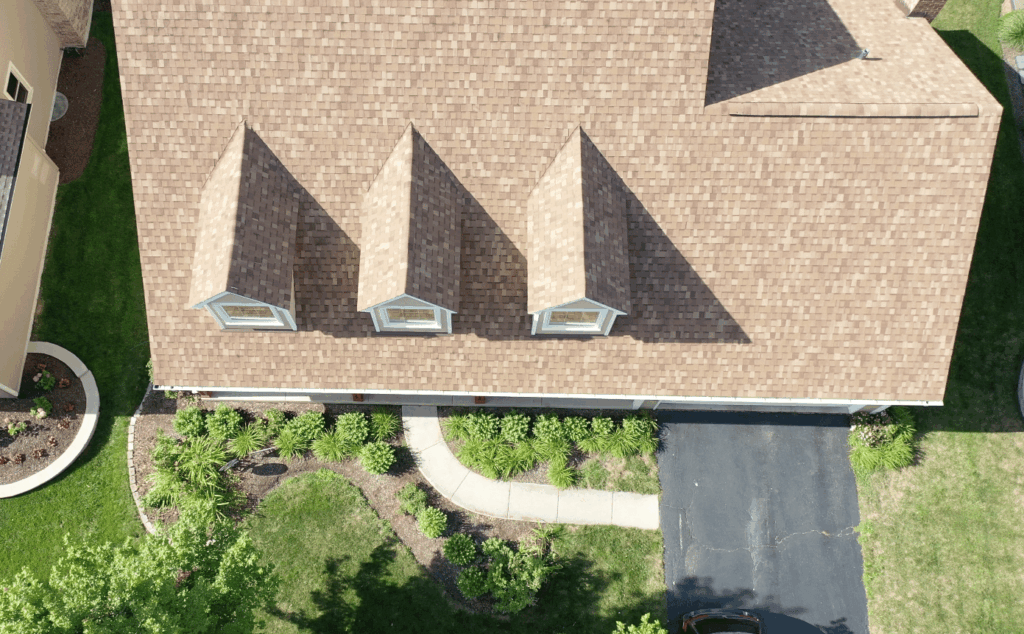
- Roof system: Condition of roofing materials, flashings, penetrations, gutters, and drainage. At Prospective, the roof is reviewed using high-definition drone imagery, which allows safe, detailed access to areas that would otherwise require walking on the surface.
- Exterior: Siding, trim, windows, doors, grading, and drainage conditions around the home.
- Structural components: Foundation, framing where accessible, walls, ceilings, and floors evaluated for signs of movement, cracking, or settling.
- Electrical system: Panel, visible wiring, outlets, switches, fixtures, and operational checks throughout the home.
- Plumbing: Visible supply and drain lines, fixtures, water pressure, and drainage function.
- HVAC: Heating and cooling equipment, ductwork, filters, and system operation.
- Attic and insulation: Insulation levels, attic ventilation, and signs of moisture or intrusion from above.
- Interior: Doors, windows, floors, ceilings, stairs, and built-in components throughout every room.
Each of those areas takes time to evaluate properly. A home with three bedrooms, two bathrooms, a basement, and an attached garage is not a small scope. Multiply that across a larger home, and the math starts to make sense.
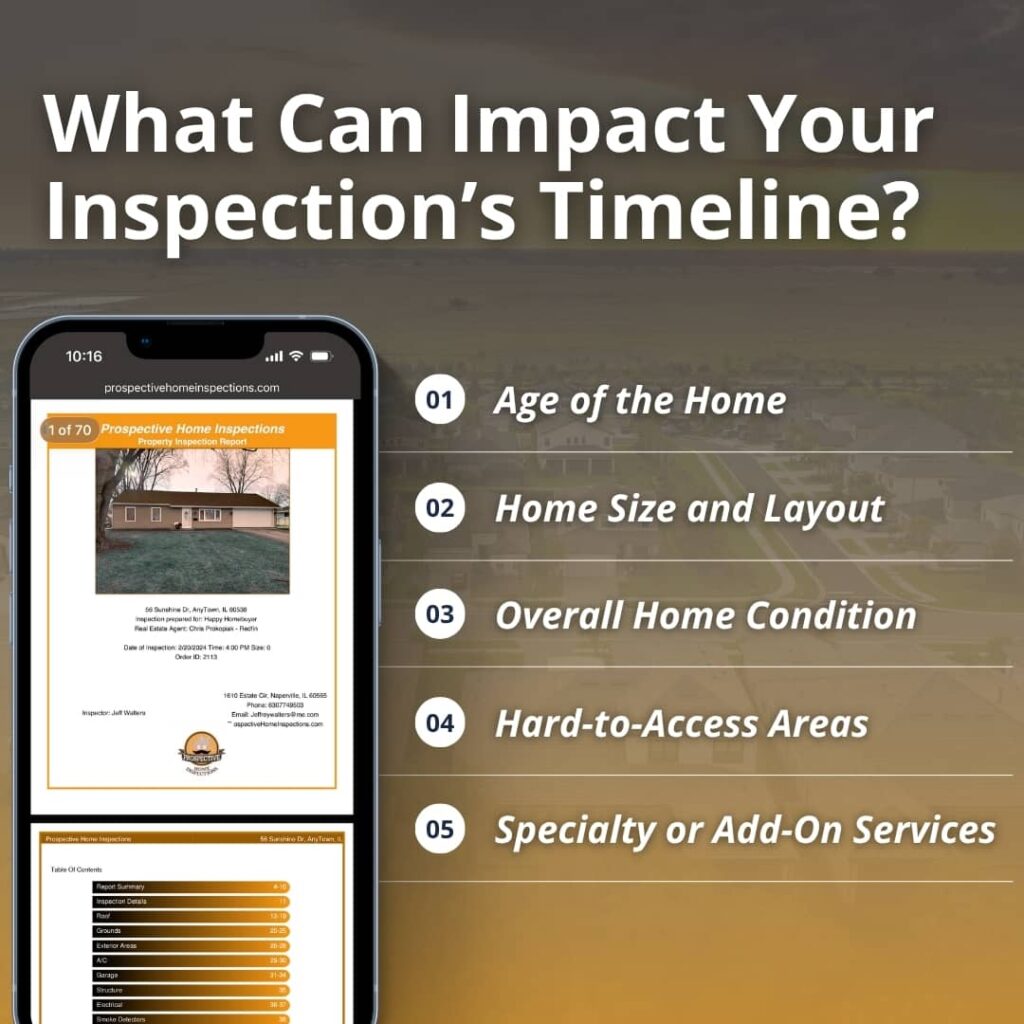
Factors That Make an Inspection Take Longer
Several variables consistently push inspection time in one direction. These are the ones that matter most.
Home size
Square footage is the most direct factor. More square footage means more rooms, more systems to evaluate, and more distance to cover. A 1,200-square-foot condo and a 3,500-square-foot single-family home are genuinely different scopes of work.
Age of the home
Older homes take more time for a few reasons. Systems are more likely to show wear, deferred maintenance, or prior repairs that need closer evaluation. Electrical panels may be older models. Plumbing materials may require more attention. Attic and crawlspace conditions in older homes often tell a longer story.
In the Naperville area, you will find everything from newer construction in the outer suburbs to homes built in the 1960s and 1970s in established neighborhoods. The age of the home shapes what an inspector is looking for and how long it takes to document.
Number of bathrooms and kitchens
Every bathroom and kitchen is a concentration of plumbing, electrical, and moisture risk. Homes with multiple bathrooms, en-suite additions, or finished basement bathrooms naturally take longer to review thoroughly.
Basement and crawlspace conditions
Finished basements add significant square footage and inspection scope. Unfinished basements with exposed mechanical systems require careful evaluation of structural components, moisture conditions, and utility systems. Crawlspaces add time based on their accessibility and condition.
Accessibility of systems
An attic with a standard pull-down access and clear walking paths is faster to evaluate than one with poor access or significant storage blocking the inspector’s path. The same applies to mechanical rooms, utility areas, and crawlspaces.
Condition of the home
A well-maintained home with no major visible concerns moves through the inspection more smoothly than a home with multiple deferred maintenance items, prior water intrusion, or systems that require extra attention. More conditions to document mean more time.
How Do Add-On Services Affect the Timeline?
Many buyers choose to add specialty services to their inspection appointment. Here is how the most common ones factor into your day.
| Service | Typical Time Added | Notes |
| Radon testing | Minimal at setup | Monitor placed early; results return after 48 hours |
| Mold/air quality sampling | 15 to 30 minutes | Samples collected during inspection; lab results follow |
| Sewer scope | 30 to 45 minutes | Camera run through the lateral line; video included in the report |
Radon testing adds very little time to the inspection day since the monitor is placed at the start and collected at the end. The 48-hour test period runs separately. Mold sampling and sewer scopes add meaningful time but are typically completed within the same appointment window.
In Illinois, radon testing is worth considering for nearly every home. Statewide data consistently show elevated radon levels in a significant percentage of homes. Approximately one in two homes tested in Illinois has radon at or above the EPA action level of 4 pCi/L, and the average Illinois indoor radon concentration is 5.1 pCi/L, already above the action level.
Testing during the inspection is the most efficient way to get that information before closing.
Sewer scopes are particularly worth considering for older homes or any property with mature trees near the sewer path. According to EPA data, about 30% of sewer pipes in the U.S. are 40 to 80 years old, and roughly 10% are more than 80 years old. In a Naperville-area home, those odds are worth knowing before you close.
What About Commercial Inspections?
Commercial inspections follow a different timeline entirely. A small commercial property may take a similar amount of time to a large residential home, but multi-unit buildings, retail spaces, or mixed-use properties can require significantly more time depending on size, system complexity, and access.
If you are evaluating a commercial property in the Naperville area, the scope and timeline are best discussed directly before scheduling.
Should You Be There for the Inspection?
Yes, when possible. Being present for the inspection gives you the opportunity to follow along, ask questions in real time, and hear the inspector’s observations firsthand rather than reading about them later in the report.
Inspectors at Prospective take time to walk clients through what they are finding and why it matters. That conversation, which happens throughout the inspection and at the end during a summary walkthrough, is one of the most valuable parts of the process. It turns a written report into something you actually understand.
Plan to arrive at or near the start time and block out the full estimated window. Leaving early means missing the summary, which is where context and next steps get explained.

When Will You Get the Report?
Prospective Home Inspections delivers detailed, photo-rich inspection reports quickly after the inspection is complete. The report is designed to be easy to read and clearly organized, so you are not sorting through pages of technical language trying to figure out what actually matters.
If mold sampling or radon testing is included, laboratory results and radon readings follow separately within the testing period timeframes.
Other Questions to Explore
Can I schedule an inspection on short notice?
Prospective offers online scheduling 24/7 with no cancellation fees. Depending on availability, same-week appointments are often possible. Getting the inspection scheduled early in the due diligence period gives you more time to review findings and follow up if needed.
Do new construction homes need an inspection?
Yes. New construction can still have workmanship issues, incomplete items, or system concerns that a standard walkthrough will not catch. A pre-drywall inspection and a final inspection before closing give buyers independent oversight during the build.
Do new construction homes take less time to inspect?
Not necessarily. New construction inspections and pre-drywall inspections have their own scope and can take just as long as a standard resale inspection. New homes can still have workmanship issues, incomplete items, or system concerns that take time to evaluate and document properly.
Is a sewer scope part of a standard home inspection?
No. A sewer scope is a specialty service that uses a camera to evaluate the underground lateral sewer line. It is offered alongside the standard inspection and adds time to the appointment. Given how frequently issues are found, it is worth considering for older homes or any property with large trees near the sewer path.
When to Call Prospective
If you are buying or selling a home in Naperville, Bolingbrook, Aurora, Lisle, or the surrounding communities, scheduling a professional inspection early in the process is the right move. This is especially true when:
- You are under contract and want a clear picture of the home’s condition before closing
- You are selling and want to identify issues before a buyer’s inspector does
- You are approaching the end of your builder’s warranty period and want to document developing conditions
- You are buying a new construction home and want independent oversight during or after the build
- You want to add radon testing, mold sampling, or a sewer scope alongside your standard inspection
Conclusion
A home inspection takes as long as it needs to. For most homes in the Naperville area, that means two to four hours of focused, methodical evaluation. The size of the home, its age, the condition of its systems, and any add-on services you choose all shape that timeline.
What does not change is the standard of care. A thorough inspection, a clear report, and time to answer your questions are what every appointment includes.
Prospective Home Inspections serves Naperville and the surrounding communities with licensed, experienced inspections backed by 30+ years in home construction. Schedule online anytime or reach out to discuss your specific property.